





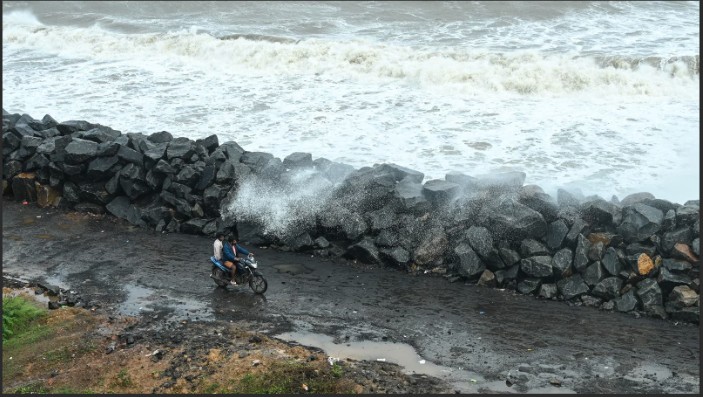
Cyclone Montha, a severe cyclonic storm, recently struck the eastern coast of India, particularly impacting the state of Andhra Pradesh and neighboring regions. The storm, whose name was given by Thailand and means a “fragrant flower” or “beautiful flower,” brought torrential rains, fierce winds, and significant disruption to life along the Bay of Bengal coast.
Path, Intensification, and Landfall
The cyclonic storm began as a deep depression over the Bay of Bengal, rapidly intensifying into a Severe Cyclonic Storm as it moved north-northwestwards.
- Landfall: Cyclone Montha made its landfall on the night of Tuesday, October 28, 2025, crossing the Andhra Pradesh coast between Machilipatnam and Kalingapatnam, near Kakinada.
- Intensity: At the time of landfall, the storm was classified as a Severe Cyclonic Storm, with maximum sustained wind speeds of 90–100 km/h, gusting up to 110 km/h.
- Affected Areas: The primary regions on alert were the coastal districts of Andhra Pradesh (Kakinada, Machilipatnam, Konaseema, etc.) and southern districts of Odisha. States like Telangana and West Bengal also experienced heavy rainfall and gusty winds as the system moved inland.
Widespread Damage and Casualties
The intense weather system left a trail of destruction, despite extensive preparations by state and central disaster response teams.
- Human Impact: One fatality was reported in Andhra Pradesh’s Konaseema district, where a woman was killed by an uprooted tree. Tens of thousands of people were successfully evacuated from low-lying coastal areas to relief camps as a precautionary measure.
- Infrastructure & Agriculture:
- Hundreds of trees and electricity poles were uprooted, causing widespread power outages and communication disruption.
- Major roads and national highways were damaged or inundated, halting vehicular movement.
- Initial reports indicate that standing crops and horticulture over tens of thousands of hectares in Andhra Pradesh were destroyed.
- Coastal erosion was aggravated, with high tidal waves flooding homes and damaging beach roads.
Preparedness and Response
Authorities in the affected states implemented high-level emergency measures to minimize loss of life and property.
- Alerts and Warnings: The India Meteorological Department (IMD) issued Red Alerts (the highest level of warning) for numerous districts, prompting schools and colleges to shut down.
- Evacuation: Disaster response teams (NDRF and SDRF) worked to evacuate over 75,000 people to designated relief camps in Andhra Pradesh and Odisha.
- Disruption: Air and rail travel faced significant disruption, with several flights and train services cancelled or diverted.
Following the landfall, the storm gradually weakened into a Cyclonic Storm and continued its movement inland, bringing heavy rainfall to interior regions like Telangana. Post-storm relief and restoration operations, including clearing debris and restoring power, are currently underway to bring normalcy back to the affected areas.